Size It Up asks a question that sounds almost childish until you actually try to answer it. How big is that, really? Not a rough guess, not "pretty big" or "kind of small," but an exact sense of scale you can commit to. Each round places a black silhouette on the board already sitting at its true size, a fixed point of reference with nowhere to hide, and next to it drops a white one for you to stretch, shrink, and nudge until your eyes finally believe the two belong side by side.
The black shape never moves. It sits there with its real measurement already locked in, acting as your ruler for the round.
The game does not overload players with modes, but the handful it offers cover different moods.
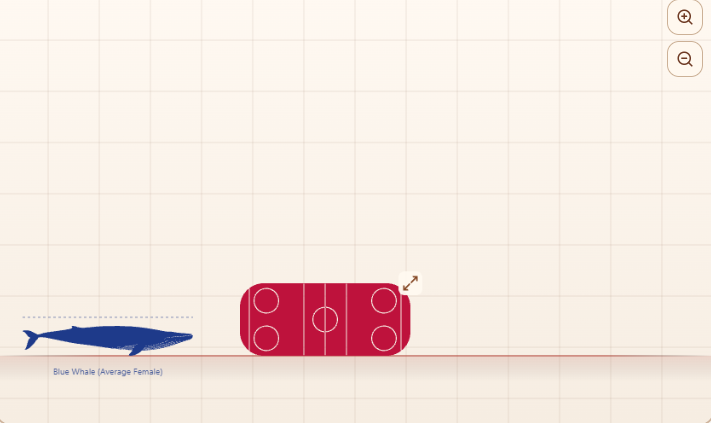
What makes this stick is the gap between guessing and knowing. You commit to a size, lock it in, and the truth shows up a second later in red. That instant correction is where the learning happens, not in reading a description beforehand. Geography Mode is a smart addition too, since it recycles the exact same resizing mechanic without feeling like a rerun of the same five rounds.
Numbers are not really the point here. Ratios are.
Look at the black silhouette and ask how many of it would fit across the white one, rather than trying to recall an exact measurement you probably do not know anyway. Pick something familiar as a mental yardstick, a car, a door frame, a dinner plate, and measure everything else against that instead of guessing blind. Extremes trip people up more than anything, so slow down when a subject is unusually massive or unusually small. Before locking in, check both length and general shape rather than just one dimension you happened to notice first. None of this clicks overnight. It comes from playing enough rounds that scale starts feeling intuitive instead of arbitrary.
That gap between what you think something measures and what Size It Up actually is turns out to be the whole appeal here. A blue whale next to a school bus, a lake next to a small country, none of these comparisons matter much on their own, but stacking five of them into a daily round gives your brain something to actually improve at. Most people are decent with numbers they see often and terrible with everything else, and Size It Up quietly exposes exactly where that line sits for you.
The daily format also does something clever for staying power. Since everyone gets the same five silhouettes, a score means something when you compare it with someone else, the same way a Wordle grid does among friends. Add Unlimited Mode for anyone who wants more reps, and Geography Mode for a different flavor of the same skill, and the whole thing holds up over weeks rather than fading after a few sessions.
None of this requires an account, a tutorial, or more than a minute per round. You drag a shape, lock in a guess, and either nod at how close you got or wince at how far off you were. That small moment of being right or wrong is really the entire game, and it works because judging size by eye is a skill almost nobody thinks to practice until something like this puts a number on it.