
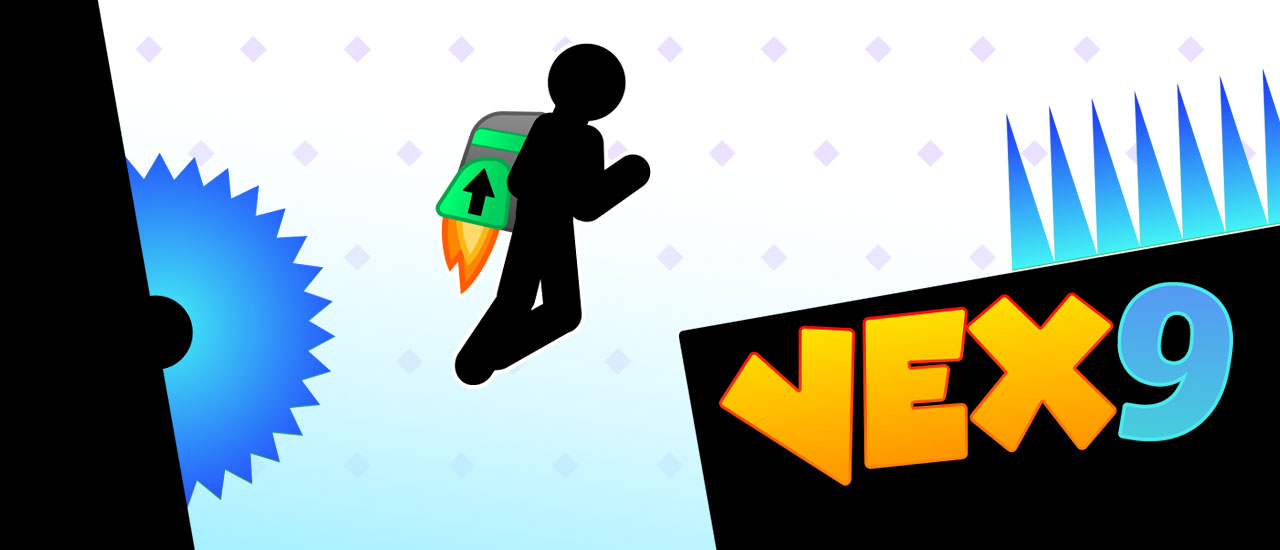
A Closer Look at the Newest Stickman Platformer. Vex 9 keeps the running, sliding and jumping that built the series, then throws a jetpack and a new challenge mode into the mix, which changes more than you'd expect from a sequel.
Nothing about the controls has really changed, and that's part of the appeal. You still run, you still slide under low ledges, you still mistime a jump and land straight on a spike three seconds into a level. What's different is how much is happening around you at once.
A typical run looks something like this:
That last part is really the whole game. Memorizing a level, dying to something new, then clearing it on the next attempt is the loop, and it hasn't lost its bite.
A few things separate this entry from the ones before it.
This works best for players who measure progress in seconds shaved off a run rather than plot beats unlocked, since there's no story to follow and no dialogue to sit through between levels. Sessions tend to run short, five or ten minutes at a time, because most levels are compact enough to retry a dozen times without it feeling like a chore, which makes it a natural fit for playing between other tasks rather than settling in for a long stretch.
The difficulty curve also filters the audience somewhat on its own. Anyone used to games that forgive a mistimed jump with a health bar or a few extra lives will probably find the instant death mechanic here frustrating rather than fun. On the other hand, players coming from speedrunning communities, or from other precision platformers where a single frame of input decides a run, tend to enjoy exactly what turns other people off, the fact that every mistake resets you immediately and every clean run feels earned rather than lucky. Challenge mode leans even further into that crowd, since it strips away the last bit of exploration or pacing and turns each stretch into a pure test of reaction time against a clock.
Here's what actually helps once you get past the first few levels:
No. You can jump straight in. Familiarity with the series helps you read level layouts a bit faster, but it's not required.
Earlier boosts were usually a single burst. This one gives sustained control over a few seconds, which changes how you approach obstacles rather than just helping you skip one.
Separate. It's its own set of trials built around speed and reaction time, not level progression.
Earlier entries in the series worked entirely on a horizontal plane, so every obstacle came down to timing a jump or a slide correctly. Adding a jetpack breaks that rule, and it shows in how the later levels are built, with vertical shafts and staggered platforms that simply wouldn't have made sense in a game without flight.
Challenge mode does something similar in a different direction. Instead of pacing difficulty across a whole act, it isolates short, dense bursts of hazards and puts a clock on them, which turns part of the experience into something closer to a scoring drill than a straightforward platformer.
Whether that adds up to a major leap or just a solid refinement probably depends on how attached you were to the older, purely ground based levels. Either way, Vex 9 is a reasonable place to start if you haven't played the series before, since the jetpack softens the punishment for a mistimed jump without making the game any less demanding.