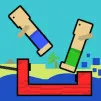
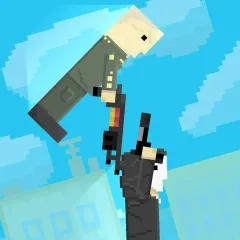
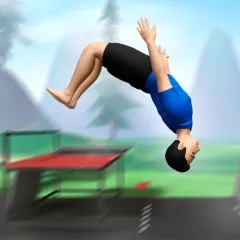
Wacky Flip turns a simple hold-and-release input into a full study of timing, rewarding players who treat every landing as a puzzle rather than a reflex test.
How Wacky Flip Handles Timing
- Hold to crouch, adjusting the length of the hold based on the height needed
- Release to launch into the jump
- Hold mid-air again to rotate through the flip
- Release once more to prepare the landing
- Progress through 10 flip challenges per stage before the next stage opens
- Move across 8 distinct environments as difficulty scales upward
What Sets It Apart
- A scoring multiplier that rewards rhythm over isolated successes
- Ragdoll-based falls that turn every mistake into its own small spectacle
- A skill unlock system introducing techniques like Pike, Scissor, and Knee Tuck as stages advance
- Environments that repeat with added height and tighter margins, forcing adaptation rather than memorization
- An instant failure state that keeps every attempt meaningful
Tips Beyond The Basics
Most players chase jump height first. Crouch duration deserves just as much attention. A shorter crouch on lower platforms usually produces cleaner rotation than a maximum hold used out of habit. Watch the multiplier as a feedback signal, not just a bonus number ticking upward. When it breaks, the culprit is almost always a rushed landing, not a mistimed flip. New skills unlock fast, so test each one on an earlier stage first. Later environments barely leave room for trial and error once the added height kicks in. Notice how a second version of any stage rarely brings new obstacles. It usually just tightens the spacing on the ones already there. Repeated falls are worth logging mentally as calibration data for hold length. Once that timing window gets identified, it stays fairly consistent across attempts.
Final Thoughts
Two buttons carry the entire experience here, yet Wacky Flip manages to make that limitation feel like a rhythm exercise rather than a stunt reel. Its falls have personality thanks to the physics work underneath them. The real payoff, though, comes from how sharply a player starts reading each hold and release window as the stages pile on difficulty.