Catdoku: A Cozy Logic Puzzle Built Around Cats. Colorful regions replace numbers in this cozy logic puzzle. Place one cat in every row, column, and region, and keep each kitty well away from its nearest neighbors.
How to Play
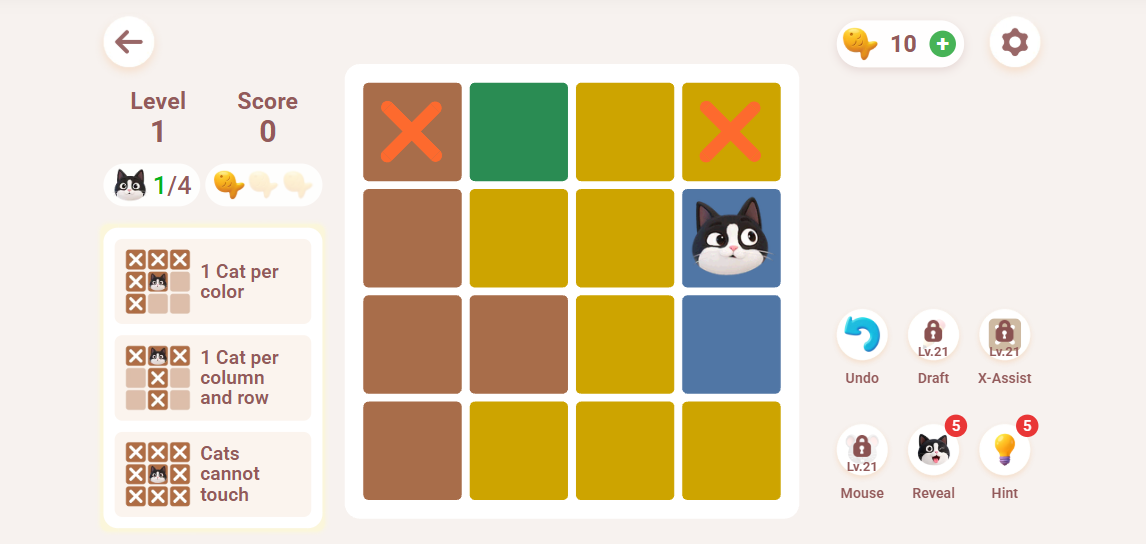
In Catdoku, the board is divided into colored regions and no numbers appear anywhere. You fill the grid by following four rules:
- One cat in every row
- One cat in every column
- One cat in every colored region
- No two cats may touch, even diagonally (the Aloof Rule)
Controls are easy to pick up:
- Click a cell once to mark an X
- Double click to place a cat
- Click the cell again to erase it
Key Features In Catdoku
Catdoku starts gently and gets sharper as you progress.
- Compact beginner boards teach the rules in a few minutes
- Larger grids bring winding regions and trickier links between neighboring cells
- Daily challenges offer a fresh board and reward faster solving times
- Careless placements carry a cost, so every move needs a reason
- Bright colors and cat artwork keep the mood relaxed
Tips for Better Solving
- Begin with the smallest region. Fewer open cells means a forced placement appears sooner.
- Look for a region that sits entirely inside one row or column. Its cat must live there, so cross out every other cell on that line.
- Remember that a 2 by 2 block can hold only one cat, since cats cannot touch.
- Mark an X on all eight neighbors of each placed cat right away.
- If 3 regions fit inside 3 rows, those rows belong to them. Clear every other cell in those rows.
- Rescan rows, columns, and regions after every placement, because one cat often unlocks another.
- When you are stuck, test a cell in your head. If the guess leads to a contradiction, that cell must be empty.
FAQs
Is this game similar to Sudoku?
It shares the grid, but colors and positions replace numbers.
Can cats touch diagonally?
No. The Aloof Rule blocks all eight surrounding cells.
Do I need to guess?
Rarely. Well built boards have one solution that logic can reach.
Conclusion
Catdoku is easy to learn and hard to put down. The rules fit in a single breath, yet every board asks you to weigh rows, columns, colors, and neighboring cells at the same time. That balance keeps each session short but satisfying, whether you have five spare minutes or a whole evening for a large grid. Each solved puzzle trains your eye for patterns, and the daily challenges give you a reason to come back and beat your own best time. Open a board, start with the smallest region, and see how far one good deduction can take you.